
How to Choose the Right QA Partner for Your Business
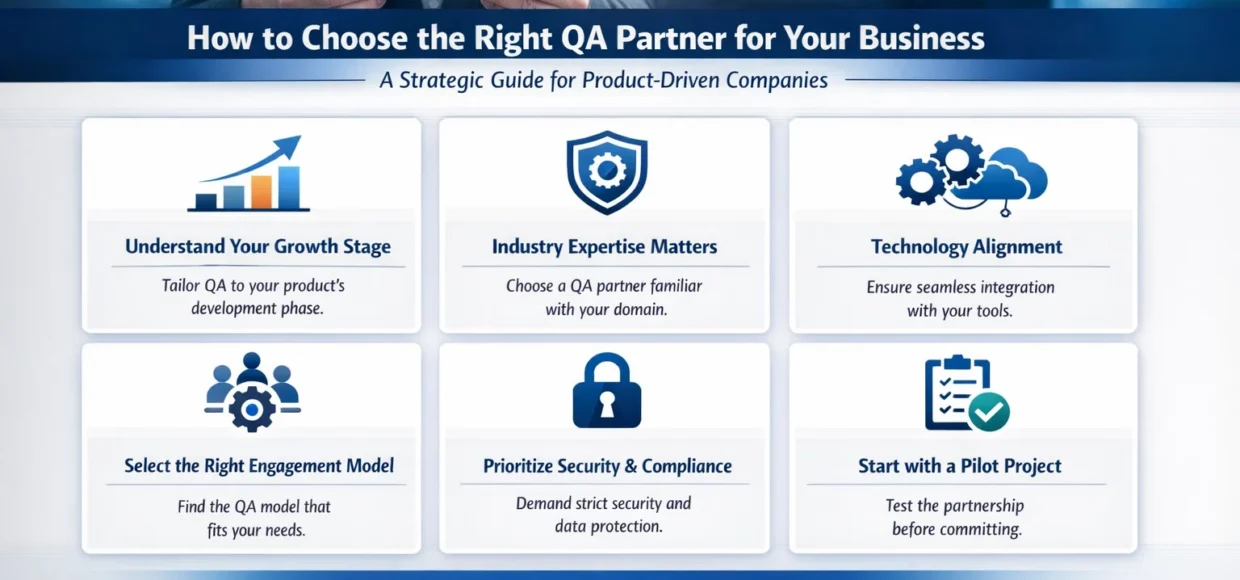
How to Choose the Right QA Partner for Your Business
A Practical Guide for Product-Driven Companies
Why Choosing the Right QA Partner Is a Strategic Business Decision
In today’s digital-first economy, software quality is no longer a technical afterthought-it’s a direct driver of brand reputation, customer retention, and revenue growth.
As organizations accelerate digital transformation, the role of Quality Assurance (QA) has expanded well beyond bug detection. The right QA partner helps businesses release faster, scale safely, and protect user trust. The wrong one? It can slow development, increase costs, and expose products to avoidable risks.
Industry leaders increasingly recognize that QA partnerships are strategic decisions. And with growing complexity across platforms, devices, regulations, and user expectations, selecting the right partner has never mattered more.
Step One: Understand Your Product’s Stage of Growth
Before evaluating QA providers, companies must clearly define where their product stands today. In practice, QA needs vary significantly depending on maturity.
Common Product Stages and QA Needs
Early / Validation Stage
At this stage, speed and adaptability are critical. Products evolve quickly, and testing must support rapid iteration rather than rigid processes.
Growth / Stability Stage
As user numbers increase, quality becomes a revenue issue. Regression testing, automation, and release reliability are essential to prevent costly disruptions.
Scale / Enterprise Stage
Here, QA must support global users, regulatory compliance, and high availability. Dedicated teams, advanced automation, performance testing, and security validation become non-negotiable.
Short and simple: QA strategy must align with business reality. A mismatch often leads to overspending-or under-testing.
Industry Expertise: Why Generic QA Is No Longer Enough
One of the most common mistakes organizations make is choosing QA partners based solely on general capability rather than domain expertise.
Industry-Specific Knowledge Makes a Measurable Difference
- Fintech: Secure transaction handling, regulatory compliance, and fraud prevention testing
- Healthcare: Data privacy, workflow accuracy, and compliance with health regulations
- E-commerce: Payment reliability, peak-load performance, and cross-device UX
- SaaS: Integration stability, user-role validation, and subscription logic
In real-world scenarios, QA teams familiar with industry-specific risks consistently detect issues earlier and reduce production failures.
Technology Alignment Is a Critical Success Factor
A QA partner must integrate seamlessly into existing development ecosystems.
This includes compatibility with:
- Bug tracking and project management tools
- CI/CD pipelines
- Automation frameworks
- Cloud environments
When QA workflows align with development workflows, teams move faster and collaborate more effectively. When they don’t, friction increases and quality suffers.
Selecting the Right Engagement Model
Different organizations require different QA engagement models. The most effective partnerships are built on the right structure from the start.
Common QA Engagement Models
- Time & Material: Ideal for evolving requirements and early-stage products
- Dedicated QA Teams: Best for long-term products requiring deep domain knowledge
- On-Demand / Crowd Testing: Useful for rapid device, geography, and localization coverage
- Managed QA Services: Suitable for organizations seeking end-to-end QA ownership
In practice, many successful companies evolve their model over time-starting flexible, then moving to dedicated teams as products mature.
Communication, Reporting, and Transparency
Technical capability alone is not enough. High-performing QA partners are defined by how clearly they communicate.
Effective QA reporting should:
- Clearly explain what was tested
- Prioritize issues by business impact
- Provide actionable reproduction steps
- Include visual evidence where appropriate
Poor communication remains one of the leading causes of failed QA engagements-even when testing skills are strong.
Security and Compliance: A Non-Negotiable Requirement
QA partners often gain access to sensitive environments, source code, and user data. As such, security standards must be clearly defined and enforced.
Key expectations include:
- Confidentiality agreements
- Secure data-handling practices
- Compliance awareness where applicable
- Controlled access to systems and environments
Organizations are advised to treat QA security reviews with the same seriousness as vendor due diligence.
Pilot Projects: The Smart Way to De-Risk the Decision
Leading companies rarely commit to long-term QA contracts without validation.
A short, paid pilot project allows organizations to assess:
- Testing quality
- Communication standards
- Responsiveness
- Cultural and workflow alignment
This approach significantly reduces risk and sets clear expectations for long-term collaboration.
Common Pitfalls Organizations Should Avoid
Industry experience highlights several recurring mistakes:
- Selecting partners based solely on cost
- Treating QA as a final-stage activity
- Over-automating or under-investing in automation
- Ignoring time zone and communication alignment
In many cases, these issues lead to higher downstream costs and delayed releases.
Choosing a QA Partner Is an Investment in Confidence
The right QA partner does more than test software-they safeguard user experience, protect brand credibility, and enable sustainable growth.
As competition intensifies and user tolerance for defects decreases, organizations that invest thoughtfully in QA partnerships gain a measurable advantage.
The message is clear: QA is no longer optional, and choosing the right partner is a strategic move that pays dividends long after release.
About the Author
This article reflects insights drawn from over a decade of hands-on experience in quality assurance across fintech, healthcare, EdTech e-commerce, and SaaS environments. The guidance is based on real-world delivery challenges, enterprise-scale testing programs, and successful long-term QA partnerships.